

Raise your hand if you had a Dubai trip, a Doha stopover, or a Maldives holiday booked for early 2026. Thousands of people did. And then, on the morning of February 28, 2026, everything changed. The news came fast: a joint US-Israeli military operation against Iran had been launched. Within hours, airspace across the Gulf shut down like a row of falling dominoes. Flight information boards at airports from Hong Kong to London started filling up with red. Cancelled. Cancelled. Cancelled. Everyone is now wondering whether the Middle East conflict will ruin their vacation travel. We have discussed all the applicable details as well as smart tips to help you complete your upcoming vacation without any worry.
Will the Middle East War Create Problems in Your Vacation Travel?
You may not be traveling to the Middle East, but the ongoing conflict in the region could still affect your vacation plans.
From flight cancellations and airspace closures to longer travel times and rising ticket prices, geopolitical tensions are creating ripple effects across the global travel industry. Many travelers are surprised to learn that a conflict thousands of miles away can impact a holiday in Europe, Asia, or even Australia.
If you’re booking an international trip this year, understanding these risks can help you avoid unexpected disruptions and travel with greater confidence.
Months later, the situation has partially stabilised – but the ripple effects on global travel are still very much being felt. If you have a vacation planned in or through the Middle East, or if rising airfares and rerouted flights are messing with your travel budget, this piece is for you.
Travel Advisory: Iran, Iraq, Syria, and Lebanon are currently at Level 4: Do Not Travel. The UAE, Saudi Arabia, Qatar, Bahrain, Kuwait, Jordan, and Oman remain at Level 3: Reconsider Travel as of June 2026. Check your government’s official advisory before making any bookings.
What Actually Happened and When
On February 28, 2026, the United States and Israel launched coordinated strikes on Iran. Iran responded with a wide-ranging counter-offensive, firing missiles and drones at civilian infrastructure across neighbouring countries – including airports and hotels in Qatar, Kuwait, and the UAE.
The scale of the disruption was immediate and stunning. Dubai International Airport alone – recently named the world’s busiest international airport – had to cancel at least 80 percent of incoming and outgoing flights within the first 48 hours. Hamad International in Doha and Abu Dhabi’s Zayed International were also severely hit.
Emirates and flydubai temporarily halted all operations, while Etihad suspended all departures from Abu Dhabi. For travellers either in the region or en route to it, the weeks that followed were a logistical nightmare.
The situation has since evolved. UAE airspace formally reopened in early May. But the scars – on traveller confidence, on airline schedules, and on global aviation economics – are still healing.
The Flight Chaos: Cancelled, Rerouted, Delayed
Let’s be direct about the scale of what happened to global aviation. This was not a local disruption. Because Dubai, Doha, and Abu Dhabi serve as critical transit hubs connecting Europe, Africa, South Asia, and Southeast Asia, their closure cascaded across flight networks worldwide.
- 5,000+ Flights cancelled in the first 48 hours of conflict
- 27 Million Passengers lost across 9 major Middle East airports in March–April
- 46.6% Drop in demand for Middle Eastern carriers in April 2026 (IATA)
- 14% Overall Middle East arrival decline in Q1 2026
At the peak of the disruption, countries including Iran, Iraq, Israel, Jordan, Kuwait, Qatar, Bahrain, Syria, and the UAE all enforced full or partial airspace closures, with 3,000-3,400+ flights cancelled during the initial disruption period alone.
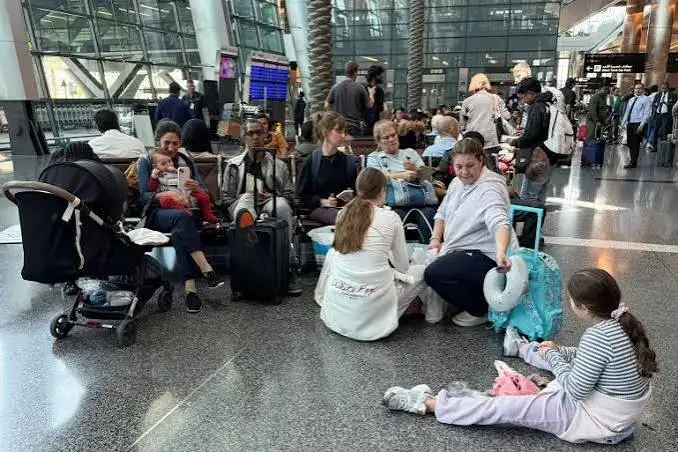
Even months later, some major carriers have suspended key destinations well into the future. American Airlines cancelled its JFK–Tel Aviv and Philadelphia-Doha routes through all of 2026, with a restart not targeted until January 2027.
As someone who closely follows aviation and travel industry developments, I’ve noticed a pattern whenever major geopolitical events occur. Airlines prioritize passenger safety and operational stability, often rerouting flights away from conflict zones. While most travelers eventually reach their destinations safely, disruptions can lead to delays, missed connections, higher fares, and last-minute itinerary changes.
Country-by-Country Travel Status (June 2026)
This is where things stand as of early June 2026. Treat this as a general overview – always verify with your government’s official travel advisory portal before booking anything.
| Country / City | Advisory Level | Flights |
|---|---|---|
| Iran | Level 4 – Do Not Travel | Airspace closed |
| Iraq | Level 4 – Do Not Travel | Airspace closed |
| Lebanon | Level 4 – Do Not Travel | Severely limited |
| Israel | Level 4 – Do Not Travel | Suspended |
| UAE (Dubai) | Level 3 – Reconsider | Mostly resumed; subject to closures |
| Qatar (Doha) | Level 3 – Reconsider | Mostly resumed; subject to closures |
| Saudi Arabia | Level 3 – Reconsider | Partially open; corridor congestion |
| Jordan | Level 3 – Reconsider | Partially restricted |
| Oman | Level 2 – Exercise Caution | Open; some overflow congestion |
| Egypt | Generally Safe | Fully operational; +16% arrivals |
Middle East Vacation Travel Disruption: The Tourism Numbers Don’t Lie
If you want to understand just how badly the Middle East travel industry has been hit, look at the data. These are not estimates or projections – these are real numbers from UN Tourism and Oxford Economics.
Middle East arrivals dropped 14% in Q1 2026, with several Gulf destinations recording strong declines. The conflict is expected to reduce global international arrival growth by 1 to 2 percentage points below the initial forecast of 3-4% for the full year.
Oxford Economics projects that inbound arrivals to the Middle East could decline 11-27% year-on-year in 2026 compared to the December forecast that had projected 13% growth – translating to a loss of 23 to 38 million international visitors and between $34 billion and $56 billion in visitor spending.
The World Travel and Tourism Council (WTTC) has estimated the region is losing approximately $600 million a day in tourism revenue as a direct result of the conflict.
The contrast with where that demand has gone is stark. Europe and Africa each grew 4 percent in Q1 2026, Central America rose 18 percent, and Oceania increased 9 percent – with much of this growth driven by demand that would otherwise have headed to Gulf destinations.
Why Your Flight Tickets Are Getting Pricier – Even If You’re Not Flying to the Middle East
Here’s something a lot of travellers don’t realise: you don’t need to be flying to Dubai for this conflict to hit your wallet. The Middle East is a central cog in the global aviation machine.
Dubai (DXB), Doha (DOH), and Abu Dhabi (AUH) together handle roughly 14% of all international transit traffic globally. When those hubs close or restrict operations, airlines serving Europe–Asia routes – a massive corridor – are forced to reroute. Longer routes mean more fuel. More fuel means higher ticket prices.
Jet fuel prices doubled in under three weeks after the conflict began, leading to higher ticket prices for travellers globally in 2026. Carriers that previously ran efficient 7-8 hour hops from European cities to Southeast Asia via Dubai are now flying significantly longer routes via Turkey, India, or sub-Saharan Africa.
The spike in oil prices and jet fuel shortages in some markets has reduced flight capacity and pushed airfares higher in regions beyond the Middle East – and this pressure is expected to persist for the foreseeable future.
Your Travel Insurance Won’t Save You – Here’s the Brutal Truth for your Vacation Travel
This is the part that stings. Many people assume that travel insurance is a safety net for any kind of disruption. When it comes to war, it almost never is.
Travel expert Brian Kelly told ABC News: “War and related military actions are broadly excluded from coverage under almost every standard travel insurance policy. Unless a traveller purchased a policy with a ‘cancel for any reason’ benefit before departure, protections for cancellations, evacuations, or related costs arising from this kind of conflict are typically not provided.”
The Middle East conflict is classed as a “known incident” from February 28, 2026 onwards, meaning travel insurers automatically exclude it as a valid reason for a claim war, invasion or armed conflict is a standard exclusion in virtually every policy.
What You Can Still Do If Your Vacation Travel Is Affected?
- If your airline cancelled the flight, you’re entitled to a full refund or rerouting – push for this first.
- Check if your credit card has built-in trip protection (some premium cards cover up to ₹8–10 lakh in travel disruptions).
- If you bought a Cancel For Any Reason (CFAR) policy before February 28, 2026, you may still have partial coverage – file immediately.
- Submit a claim anyway and frame it around “airspace closure” rather than “war” – some insurers may cover delay costs under different clauses.
- Save every single receipt – hotels, rebooking fees, meals, transport – in case any portion is claimable.
Where Smart Tourists Are Going Instead for Vacation Travel?
The upside of all this disruption, if there is one, is that other destinations are getting some much-deserved attention. British Airways, for example, added flights to Singapore and Bangkok specifically to capture demand shifting away from the Gulf. Here’s where the crowds are heading.
Thailand
Always a safe bet. Easy visas, direct flights from India, and prices that forgive even the most spontaneous of bookings.
Greece
Europe’s summer darling. Arrivals up as demand redirects from Gulf transit routes. Santorini and Athens are buzzing.
Singapore
Major carriers adding capacity on this route. Clean, safe, visa-easy for Indians – and the food more than justifies the trip.
Jamaica / Caribbean
British Airways and Virgin expanded Caribbean routes as the Gulf dried up. Demand is rising but prices remain reasonable.
Mexico / Central America
Central America saw 18% arrival growth in Q1 2026. Costa Rica in particular is having a moment with redirected European tourists.
Egypt
Arrivals up 16% – the one Middle East-adjacent country actually benefiting. Pyramids, the Nile, Red Sea diving – all very much open for business.
Your Practical Travel Action Plan for 2026
Whether you’re trying to salvage an existing booking or plan a fresh trip, here’s what you actually need to do right now.
If You Have an Existing Middle East Booking
- Contact your airline directly and check if your flight is still operating before heading to the airport.
- If the flight was cancelled by the airline, demand a full refund – you’re legally entitled to one under most aviation consumer protection rules.
- Check your credit card’s travel protection clause – many premium cards offer trip cancellation coverage that standard insurance doesn’t.
- For hotel and tour bookings, contact providers directly; many are offering penalty-free date changes given the circumstances.
- If you’re already in the region, register with your embassy and stay close to official communication channels.
If You’re Planning a New Trip
- Monitor your government’s travel advisory portal weekly – the situation can shift quickly.
- Avoid booking non-refundable fares to or through the Middle East until Level 3 advisories are lifted.
- Always purchase travel insurance with a Cancel For Any Reason (CFAR) add-on – standard policies are no help in conflict situations.
- Build in extra transit time if your route goes anywhere near Gulf airspace – delays remain possible.
- Consider alternative routing through Turkey, India, or East Africa for Europe-Asia connections.
- If you’re using Dubai or Doha as a transit point, have a contingency plan – a backup routing through Istanbul or Mumbai could save you days of being stranded.
Expert Perspective: The honest answer to whether you should travel to the Gulf right now is: it depends on your risk tolerance and how flexible your plans are. Major airports have resumed, but the situation is not stable in the conventional sense. A single escalation event can ground flights within hours – as we saw in early May when UAE airspace briefly closed again. If your travel timeline is fixed and the consequences of being stranded are severe, build redundancy into your plan or rebook to a different destination altogether. Travel should be an adventure, not a gamble
In the End
You can make your upcoming holiday journey foolproof if you know how to navigate the global tourism disruption. The ongoing escalation in the Middle East have hampered the vacation travel around the world. The ripple effect is being felt in every corner directly or indirectly. The war has also created a gap in logistics, that has caused an increase in the crude oil prices.
Airlines around the world have adjusted routes, modified schedules, and issued travel advisories in response to changing conditions. Smart travelers should choose alternative destinations that have minimal impact of this war.